Full Body Workout 3 Days a Week: A Beginner Plan With Progression
If you are new to lifting, or you only have three days a week, a full body workout is the most effective plan you can follow. You train every major muscle three times a week, you practise each lift often enough to learn it fast, and a missed day never leaves a muscle group untrained for two weeks.
This guide gives you a complete 3-day full body workout plan for beginners, explains why it works, and shows exactly how to progress it for the next 12 weeks.
Why Full Body, 3 Days a Week?
Muscle grows best when each muscle is trained at least twice a week. A classic "bro split" hits each muscle once. A full body routine hits each one three times, with fewer sets per session, so every workout is fresh and high quality.
For beginners it has three extra advantages:
- Faster skill learning. Squatting three times a week teaches the movement far quicker than once.
- Flexible schedule. Any three non-consecutive days work: Monday, Wednesday, Friday or Tuesday, Thursday, Saturday.
- Forgiving. Miss a day and you still trained everything twice that week.
If you are deciding between splits, our comparison of Push/Pull/Legs vs Upper/Lower explains when to move on. For most people in their first year, full body is the right call.
The Weekly Schedule
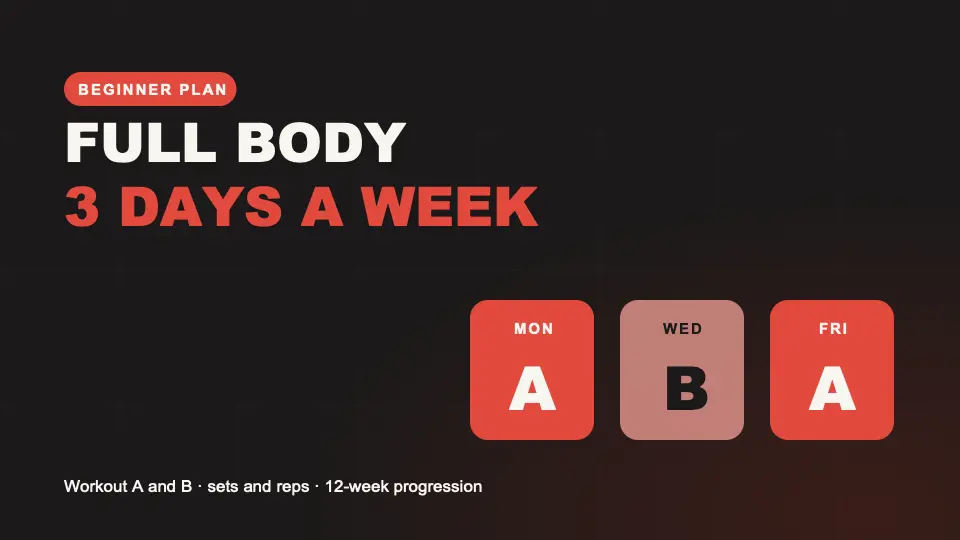
Alternate two workouts, A and B, with at least one rest day between sessions.
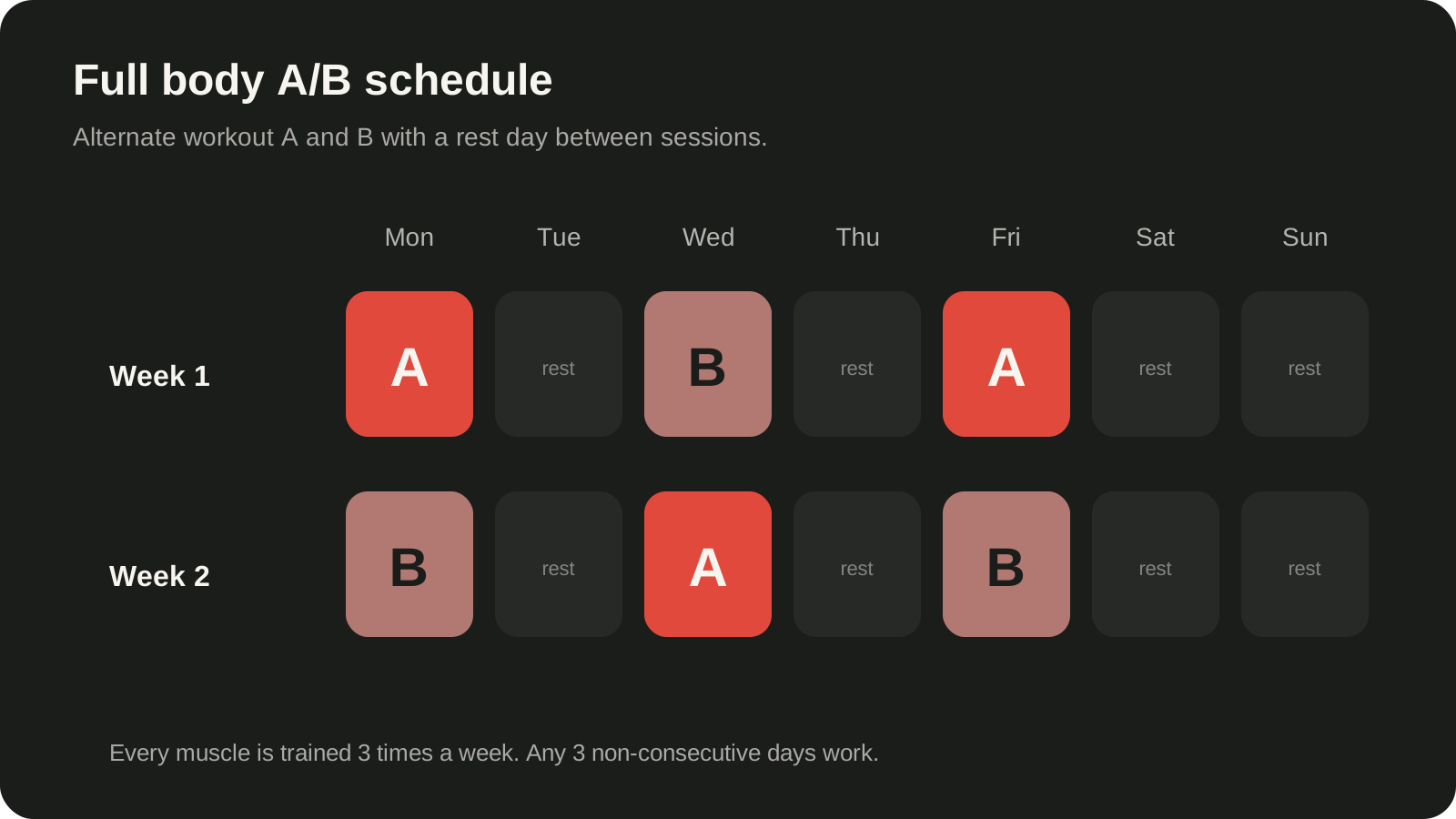
Week 1:  Mon A   Wed B   Fri A
Week 2:  Mon B   Wed A   Fri B
Each workout takes about 45 to 60 minutes including warm-up.
Workout A
| Exercise | Sets × Reps | Rest |
|---|---|---|
| Barbell back squat or goblet squat | 3 × 6 to 8 | 2 to 3 min |
| Bench press or push-up | 3 × 6 to 10 | 2 min |
| Barbell or dumbbell row | 3 × 8 to 10 | 2 min |
| Romanian deadlift | 2 × 8 to 10 | 2 min |
| Dumbbell lateral raise | 2 × 12 to 15 | 60 to 90 s |
| Plank | 3 × 30 to 45 s | 60 s |
Workout B
| Exercise | Sets × Reps | Rest |
|---|---|---|
| Deadlift or trap-bar deadlift | 3 × 5 | 3 min |
| Overhead press | 3 × 6 to 10 | 2 min |
| Lat pulldown or assisted pull-up | 3 × 8 to 12 | 2 min |
| Walking lunge or split squat | 2 × 10 per leg | 90 s |
| Dumbbell curl | 2 × 10 to 12 | 60 to 90 s |
| Dips (assisted) or close-grip push-up | 2 × 8 to 12 | 90 s |
Training at home or in a small gym? Swap barbells for dumbbells: goblet squat, dumbbell bench press, one-arm row, dumbbell Romanian deadlift and dumbbell shoulder press work just as well for a beginner.
How Many Sets Is Enough?
Across the week this plan gives every major muscle about 8 to 12 hard sets (counting a compound lift as half a set for the muscles it trains indirectly), the range where beginners grow well without excess fatigue.
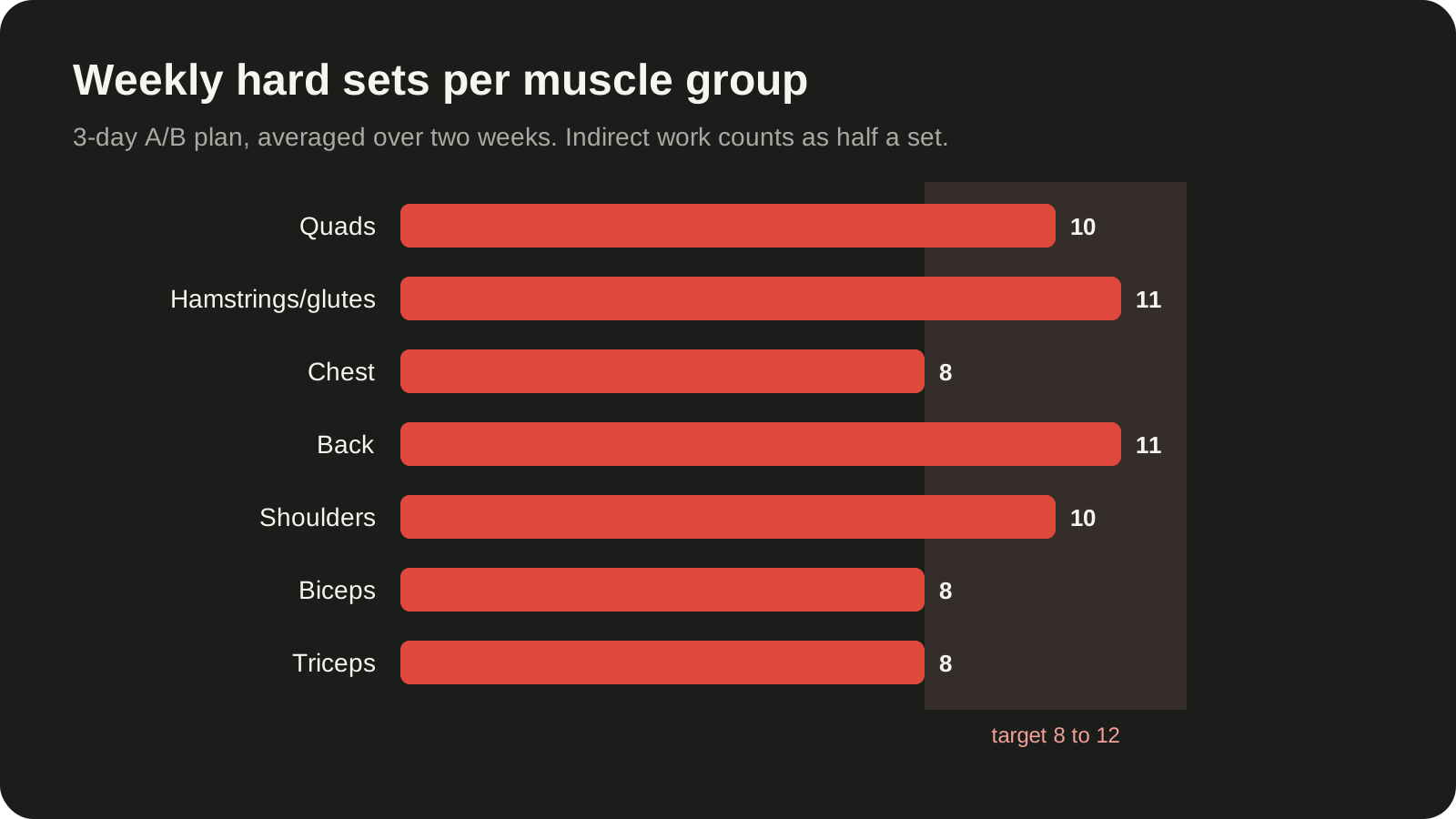
Beginners do not need 20 sets per muscle. Recovery is the limit, and more volume early on mostly adds soreness. Add sets later, when progress slows.
How Hard Should Each Set Be?
Finish most sets with 1 to 3 reps left in the tank. You should be slowing down, but your form should still look the same as on rep one.
- Too easy: you could do 5 or more extra reps. Add weight.
- Right: the last 2 reps are a real effort.
- Too hard: form breaks or you fail before the target reps. Lower the weight.
How to Progress: Double Progression
Use the same simple rule on every exercise:
Pick the rep range, for example 3 sets of 6 to 8.
Start with a weight you can lift for 6 on every set.
Each session, try to add a rep to some sets.
When you hit 8, 8, 8, add the smallest weight jump.
Drop back to 6 reps and climb again.
Weight jumps: 2.5 to 5 kg on squats and deadlifts, 1 to 2.5 kg on presses and rows, the next dumbbell up on small exercises. We explain this method in more depth in how to increase strength.
Your First 12 Weeks
| Weeks | Focus |
|---|---|
| 1 to 2 | Learn the lifts with light weights. Stop every set 3 to 4 reps short. |
| 3 to 8 | Add reps or weight every session using double progression. |
| 9 | Deload: same exercises, half the sets, about 10% lighter. |
| 10 to 12 | Keep progressing. Add a 4th set to the first exercise of each day if you recover well. |
Most beginners add 20 to 50% to their main lifts over this period. If a lift stalls for three sessions in a row, lower the weight by 10% and build back up.
Warm-Up (8 Minutes)
- 3 to 5 minutes of easy cardio: bike, rower or brisk walk.
- 10 bodyweight squats, 10 hip hinges, 10 band pull-aparts or arm circles.
- Two or three lighter sets of the first exercise before your working weight.
Common Beginner Mistakes
- Changing the program every week. Run the same plan for at least 8 to 12 weeks so progress can show.
- Training to failure on every set. It makes you sorer, not stronger. Keep 1 to 3 reps in reserve.
- Skipping legs or pulling work. Balance is the point of full body training.
- Not eating enough protein. Training creates the signal, food builds the muscle. Aim for about 1.6 g of protein per kg of body weight.
- Too little sleep. 7 to 9 hours is part of the program.
Want a Plan Built Around You?
This plan works for most beginners, but your equipment, schedule and goals may differ. The FitFocus AI workout generator builds a full body routine for your days, gym or home equipment and experience level in seconds, with every exercise linked to a demo. Browse the exercise library to learn each movement before your first session.
Key Takeaways
- Train full body 3 non-consecutive days a week, alternating workouts A and B.
- Do 8 to 12 hard sets per muscle per week, stopping 1 to 3 reps short of failure.
- Progress with double progression: reps first, then weight.
- Stick with it for 12 weeks, deload once, and eat enough protein.