How to Increase Stamina: The 80/20 Method and an 8-Week Plan
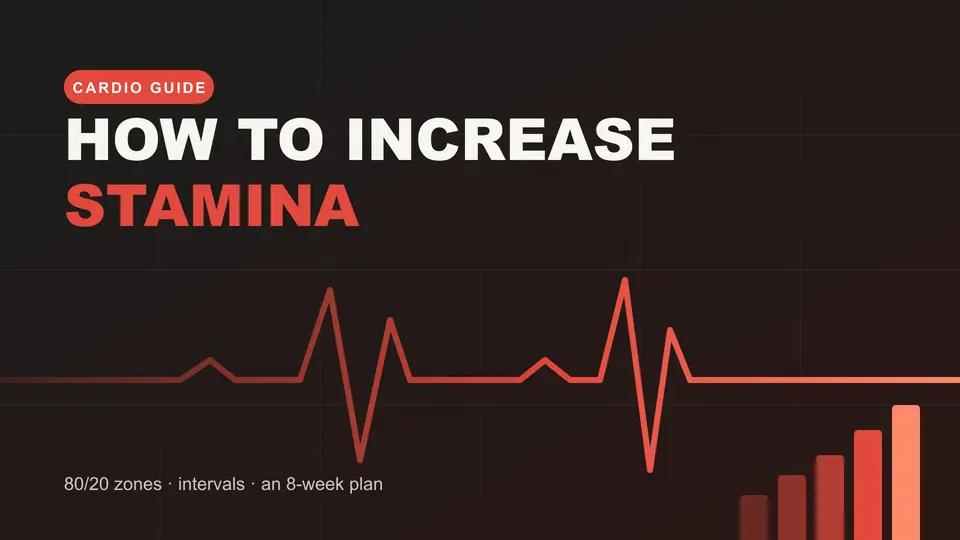
Stamina is not something you are born with or without. It is a set of adaptations: a stronger heart that pumps more blood per beat, more capillaries feeding your muscles, more mitochondria turning fuel into energy, and legs that tolerate more work before they burn out. Every one of those adaptations is trainable, and most people see real change in 6 to 8 weeks.
This guide covers what stamina actually is, the training split that builds it fastest, the exact sessions to run, an 8-week plan, and the recovery and nutrition habits that decide whether it works.
What "Stamina" Means in Practice
People use stamina, endurance, and cardio fitness interchangeably. In training terms there are three separate qualities, and you need all of them:
| Quality | What it feels like | What builds it |
|---|---|---|
| Aerobic base | Walking up stairs without getting winded, jogging for 30+ minutes | Long, easy, conversational cardio |
| Lactate threshold | Holding a hard pace without "hitting the wall" | Sustained comfortably-hard efforts |
| VO2 max | Top-end gas: sprints, hills, the last round of a circuit | Short, very hard intervals |
The aerobic base is the foundation. Threshold and VO2 max work sit on top of it. Skip the base and hard sessions stop working within a few weeks.
Step 1: Find Your Heart Rate Zones
You do not need a lab test. A rough max heart rate estimate is enough to start:
Max HR ≈ 208 - (0.7 x age)

Example, age 30:
Max HR ≈ 208 - 21 = 187 bpm
Zone 2 (60 to 70%) ≈ 112 to 131 bpm
No heart rate monitor? Use the talk test:
- Zone 2: you can speak full sentences, but you would not want to sing.
- Threshold: you can speak a few words at a time.
- VO2 max intervals: you cannot talk and do not want to.
Step 2: Train 80% Easy, 20% Hard
Studies of elite endurance athletes across running, rowing, cycling, and skiing keep finding the same pattern: about 80% of training time is easy and about 20% is hard, with very little in the middle. Recreational athletes who copy this split usually improve faster than those who run every session at a "moderately hard" pace.
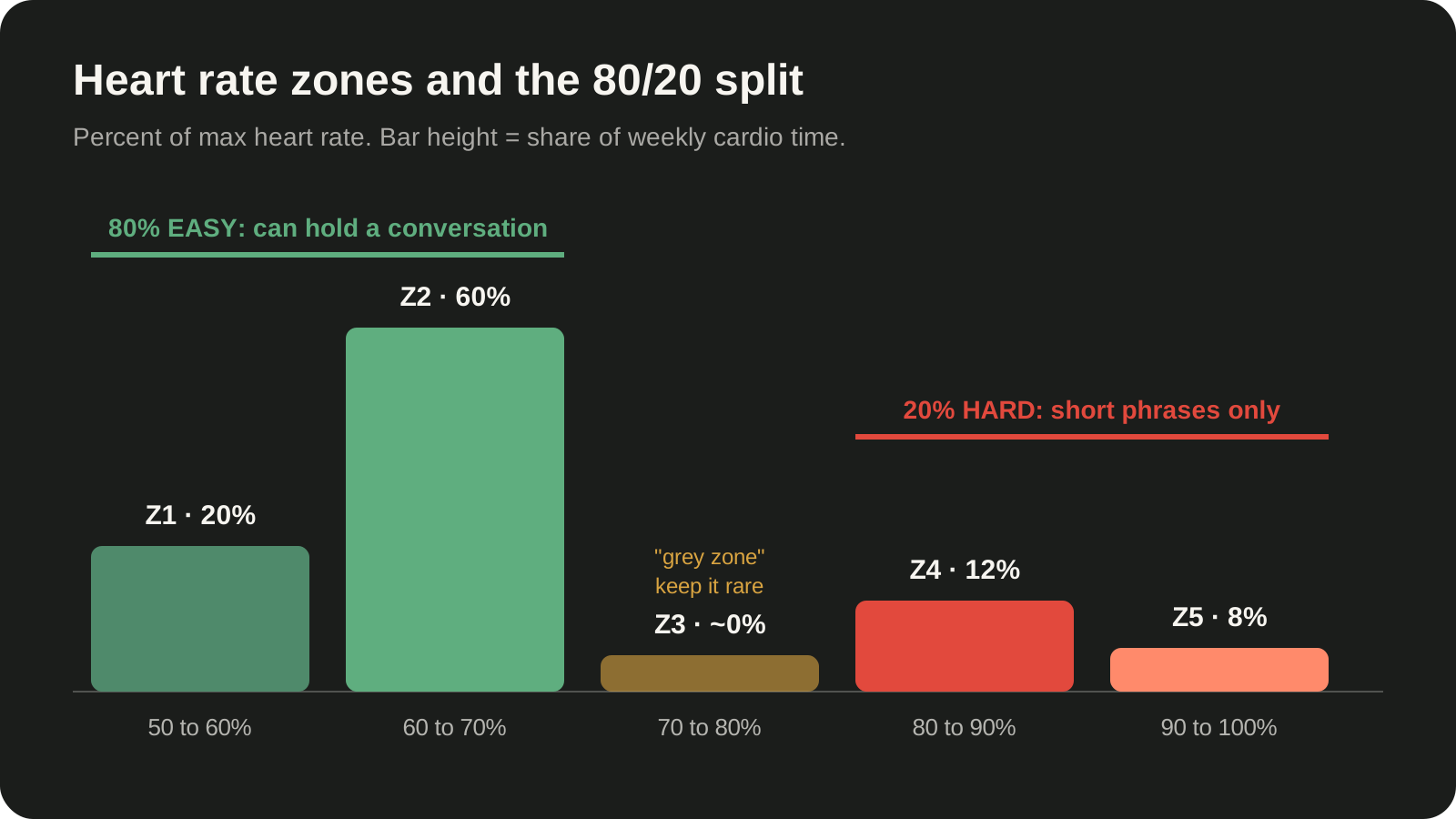
The trap is Zone 3, the "grey zone." It feels productive because it is uncomfortable, but it is too hard to recover from quickly and too easy to push your ceiling. Most people who say "I run three times a week and I am not getting fitter" are running every session here.
Easy has to feel easy. For many beginners that means jogging slower than feels natural, or mixing walking and jogging. That is fine. Your heart does not know how fast you are moving, only how hard it is working.
Step 3: The Four Sessions That Build Stamina
1. Zone 2 base session
- Duration: 30 to 60 minutes
- Intensity: conversational
- Modes: running, cycling, rowing, incline walking, swimming
- Why: builds stroke volume, capillaries, and mitochondria. This is where most of your stamina comes from.
2. Threshold intervals
Warm up 10 min easy
3 to 4 x 8 min at "comfortably hard" (a few words at a time)
2 min easy between
Cool down 5 to 10 min
3. VO2 max intervals
Warm up 10 to 15 min easy
4 to 6 x 3 min hard (near max sustainable effort)
3 min easy between
Cool down 10 min
Beginners can start with 30 seconds hard and 90 seconds easy, repeated 6 to 8 times.
4. Long session
One session per week 50% longer than your normal Zone 2 session. Keep it easy. It trains your ability to keep going when you are already tired, which is what stamina feels like in real life.
Step 4: The 8-Week Plan
Three to four cardio sessions per week, alongside your strength training.
| Week | Zone 2 sessions | Hard session | Long session |
|---|---|---|---|
| 1 | 2 x 30 min | none | 40 min easy |
| 2 | 2 x 35 min | 6 x 30 s hard / 90 s easy | 45 min |
| 3 | 2 x 40 min | 8 x 30 s hard / 90 s easy | 50 min |
| 4 (deload) | 2 x 30 min | none | 40 min |
| 5 | 2 x 45 min | 3 x 8 min threshold | 60 min |
| 6 | 2 x 45 min | 4 x 3 min VO2 max | 65 min |
| 7 | 2 x 50 min | 4 x 8 min threshold | 70 min |
| 8 (retest) | 2 x 40 min | retest (below) | 50 min |
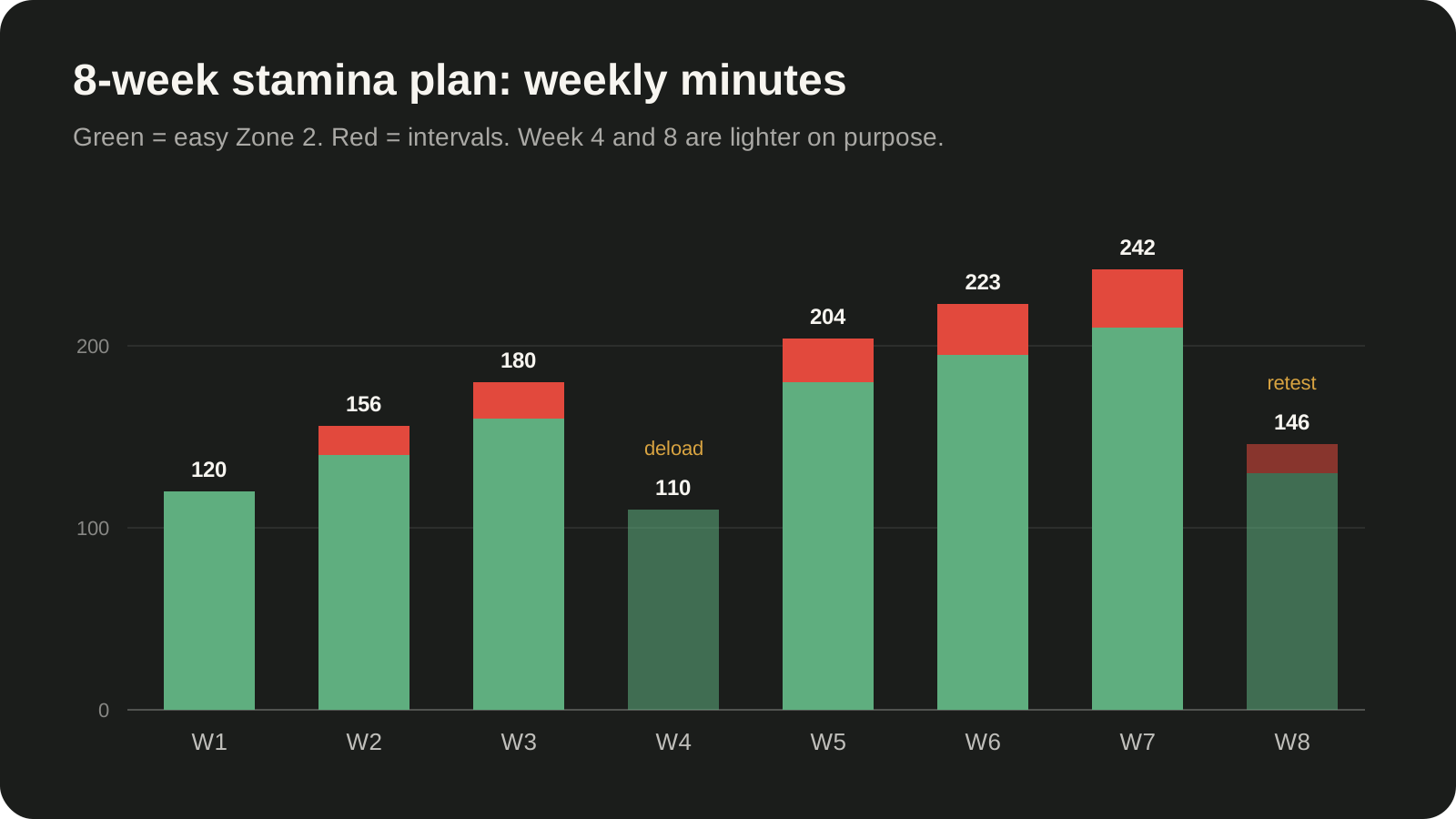
Never increase total weekly time by more than about 10 to 15%. Weeks 4 and 8 drop the volume on purpose. Fitness is built during recovery, and the lighter week lets the previous three weeks of work show up.
How to measure progress
Pick one test and repeat it in week 1 and week 8:
- 12-minute test: how far can you run, row, or cycle in 12 minutes?
- Fixed-pace heart rate: jog a set route at the same pace and note your average heart rate. Lower heart rate at the same pace means a fitter heart.
- Resting heart rate: measure on waking. A drop of 3 to 8 bpm over two months is common.
Step 5: Strength Training Improves Stamina Too
Getting stronger helps more than most people expect. Stronger legs and a stronger core mean each stride, pedal stroke, or rep costs a smaller fraction of your maximum. That lowers the effort of everything below max. Two short lower-body and full-body sessions a week are enough. Squats, lunges, step-ups, Romanian deadlifts, and planks cover most of it.
Keep heavy leg days away from your hard cardio day. Put them on the same day as easy Zone 2, or separate them by 24 to 48 hours.
Step 6: Fuel and Recover Like It Matters
- Carbohydrate is the fuel for hard sessions. Low-carb days are fine for easy Zone 2 work. Hard intervals on empty glycogen stores feel terrible and produce less adaptation.
- Protein: 1.4 to 2.0 g per kg of bodyweight per day keeps muscle recovering between sessions.
- Hydration: a pale-yellow urine colour is a simple daily check. Add electrolytes for sessions longer than an hour or in heat.
- Sleep: 7 to 9 hours. Short sleep raises heart rate at every pace and makes easy runs feel like threshold work.
- Iron: if you feel exhausted despite training well, especially if you menstruate or eat little red meat, ask a doctor to check ferritin.
Common Mistakes
- Every session at medium-hard. The most common reason stamina stalls. Slow the easy days down.
- Adding hard intervals in week one. Build two to three weeks of easy volume first.
- Jumping volume after a good week. Injuries usually show up two to three weeks after the jump, not on the day.
- Only doing cardio. Weak legs and hips limit endurance and raise injury risk.
- Judging progress by how it feels day to day. Use a repeatable test every 4 to 8 weeks.
FAQ
How long does it take to increase stamina? Most people notice easier everyday effort in 2 to 3 weeks and measurable test improvements in 6 to 8 weeks. Large aerobic gains keep coming for months and years.
Is walking enough? For beginners, brisk or incline walking is real Zone 2 training. As fitness improves you will need jogging, cycling, or rowing to keep heart rate in the zone.
Can I build stamina without running? Yes. Your heart does not care about the mode. Cycling, rowing, swimming, stair climbing, and incline walking all work, and mixing them spreads the impact load.
Do I need HIIT every day to get fit fast? No. One or two hard sessions a week is the useful dose. More than that usually leads to fatigue that makes every session worse.
Should I train when sore or tired? Easy Zone 2 is usually fine and often helps you feel better. Move the hard session to another day.
Put It Into a Weekly Plan
Knowing the split is easy. Fitting cardio, strength days, and rest into an actual week is where most plans fall apart.
FitFocus builds a personalised workout plan around your goal, schedule, and available equipment, and the AI meal planner can match your calories and carbs to your training days so hard sessions are fuelled and rest days stay lighter.
Run easy most of the time, run hard a little of the time, and give it eight weeks.