How to Increase Strength: Progressive Overload, Rep Ranges, and a 12-Week Plan
Getting stronger is the most reliable result in fitness. Beginners who follow a sensible program routinely add 20 to 50% to their main lifts in the first three to six months, and almost everyone who stalls does so for the same handful of reasons: no progression plan, too little effort, too little recovery, or too little food.
This guide covers the principles that actually drive strength, how to choose sets, reps, and rest, a 12-week plan you can start this week, and what to do when progress stops.
Strength vs Muscle Size
Strength and muscle size are related but not identical.
- Muscle size depends mostly on total hard sets per muscle per week. A wide range of rep counts works.
- Strength is muscle size plus skill: your nervous system learning to recruit more muscle fibers, fire them faster, and coordinate the movement pattern.
That skill part is why strength is specific. Squatting heavy makes you better at squatting heavy. To get strong at a lift, you have to practise it heavy, regularly.
Principle 1: Progressive Overload
Your body adapts to the demand you give it, then stops. To keep getting stronger, the demand must keep rising. You can increase:
- Load: more weight on the bar
- Reps: more reps with the same weight
- Sets: more total work
- Quality: same weight with better technique, depth, or speed
The simplest method that works for almost everyone is double progression.
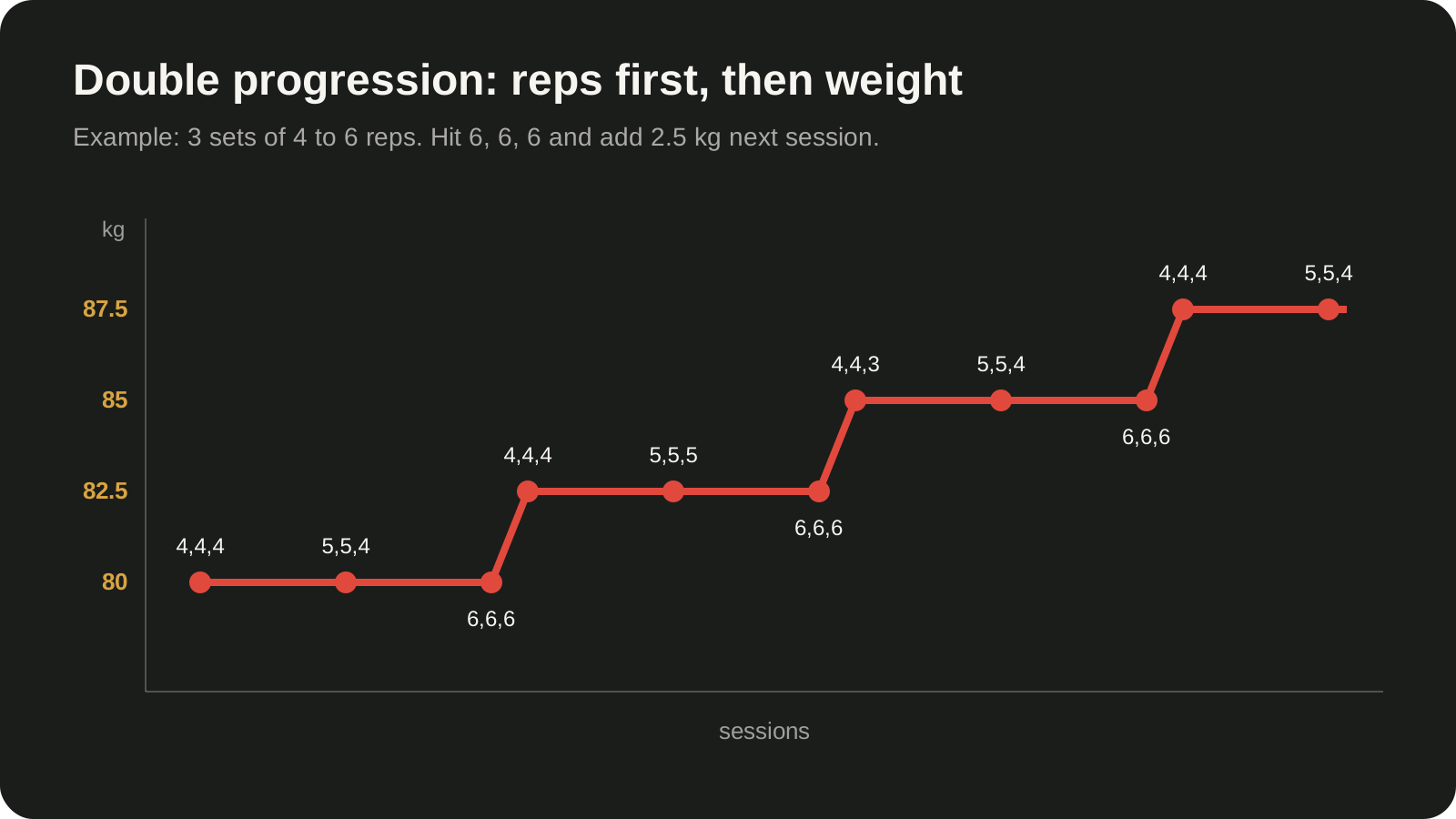
Pick a rep range, for example 3 sets of 4 to 6 reps.
Start with a weight you can lift for 4 reps on every set.
Each session, try to add reps.
When you hit 6, 6, 6, add the smallest weight jump available.
Drop back to 4 reps and climb again.
Weight jumps: 2.5 kg on lower-body barbell lifts, 1 to 2.5 kg on upper-body lifts. Smaller jumps last longer.
Principle 2: Use the Right Rep Ranges
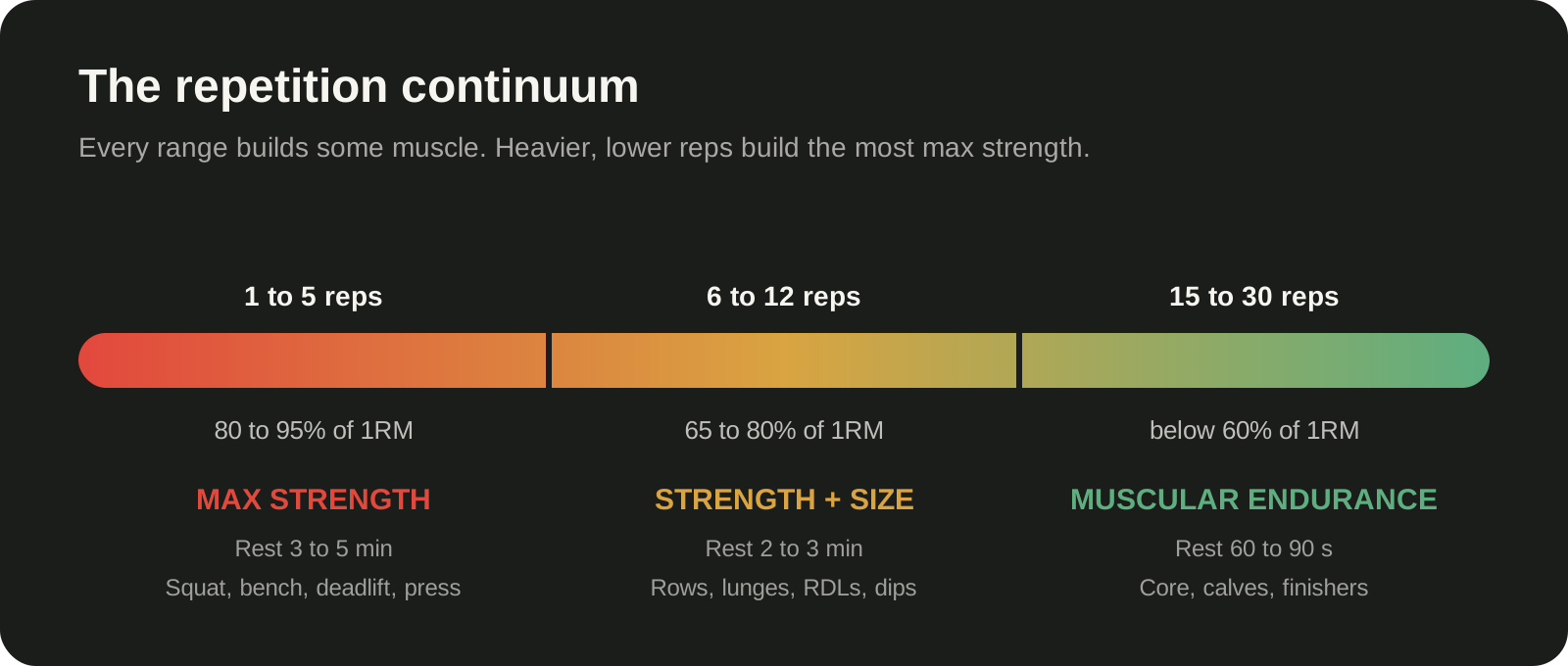
| Goal | Reps per set | Load (% of 1RM) | Rest between sets |
|---|---|---|---|
| Max strength | 1 to 5 | 80 to 95% | 3 to 5 min |
| Strength and size | 6 to 12 | 65 to 80% | 2 to 3 min |
| Muscular endurance | 15 to 30 | below 60% | 60 to 90 s |
A strength-focused program does not live only at 1 to 5 reps. The best approach for most people: main compound lifts in the 3 to 6 range, accessory lifts in the 6 to 12 range. Heavy work builds the skill, moderate work builds the muscle that the skill moves.
Rest longer than you think. Short rest feels productive but reduces how much weight you can move on the next set. For heavy compounds, 3 minutes minimum.
Principle 3: Train Close to Failure, Not to Failure
Effort matters. Sets that end with 5 or more reps "left in the tank" do little. But grinding to total failure on heavy squats or deadlifts raises injury risk and fatigue for little extra benefit.
Use reps in reserve (RIR):
| RIR | Meaning | When to use |
|---|---|---|
| 3 | Could have done 3 more | Technique work, early in a program |
| 1 to 2 | Hard, but bar speed still controlled | Most working sets on compound lifts |
| 0 | Could not do another rep | Last set of safe accessories (machines, curls) |
Principle 4: Frequency and Volume
- Frequency: train each main lift or movement pattern 2 times per week. Practising a skill twice a week beats once.
- Volume: 10 to 20 hard sets per muscle group per week covers most people. Beginners grow on the low end. Start low and add only when progress stalls.
Pick a split that fits your schedule. Full body three days a week and upper/lower four days a week both hit every lift twice. Our guide to choosing a training split compares them in detail.
The 12-Week Strength Plan
Upper/lower, four days a week. Main lifts use double progression in the 4 to 6 range, accessories in the 8 to 12 range.
Upper A
| Exercise | Sets x reps |
|---|---|
| Bench press | 3 x 4 to 6 |
| Barbell row | 3 x 6 to 8 |
| Overhead press | 3 x 6 to 8 |
| Pull-up or lat pulldown | 3 x 8 to 10 |
| Triceps and biceps | 2 x 10 to 12 each |
Lower A
| Exercise | Sets x reps |
|---|---|
| Back squat | 3 x 4 to 6 |
| Romanian deadlift | 3 x 6 to 8 |
| Walking lunge | 2 x 10 per leg |
| Calf raise | 3 x 10 to 15 |
| Plank | 3 x 30 to 45 s |
Upper B
| Exercise | Sets x reps |
|---|---|
| Overhead press | 3 x 4 to 6 |
| Weighted pull-up or heavy pulldown | 3 x 5 to 8 |
| Incline dumbbell press | 3 x 8 to 10 |
| Seated cable row | 3 x 8 to 12 |
| Lateral raise | 3 x 12 to 15 |
Lower B
| Exercise | Sets x reps |
|---|---|
| Deadlift | 3 x 3 to 5 |
| Front squat or leg press | 3 x 6 to 8 |
| Hip thrust | 3 x 8 to 10 |
| Leg curl | 2 x 10 to 12 |
| Hanging knee raise | 3 x 10 to 15 |
Schedule: Monday Upper A, Tuesday Lower A, Thursday Upper B, Friday Lower B.
Deload in weeks 6 and 12: same exercises, same weights, half the sets. Strength often jumps the week after a deload because accumulated fatigue drops away.
No Gym? Get Stronger at Home
Bodyweight training builds real strength as long as you make it harder over time:
- Slow the lowering phase to 3 to 4 seconds.
- Move to harder variations: knee push-up → push-up → feet-elevated → archer push-up.
- Go single-leg: squat → split squat → Bulgarian split squat → pistol progression.
- Add load: a backpack with books, water jugs, or a pair of adjustable dumbbells.
The rule is the same: when a set of 12 to 15 becomes easy, move to a harder variation.
Recovery and Nutrition
Training is the signal. Recovery is where you actually get stronger.
- Protein: 1.6 to 2.2 g per kg of bodyweight per day, split across 3 to 5 meals.
- Calories: at least maintenance. Strength can still rise in a mild deficit, but large deficits stall progress fast. Our guide on setting your macros walks through the numbers.
- Carbohydrates: fuel heavy sessions. Most lifters do better with carbs in the meal before training.
- Sleep: 7 to 9 hours. One bad night barely matters. A week of short sleep measurably reduces strength.
- Creatine monohydrate: 3 to 5 g per day is one of the most studied supplements available and reliably helps strength training performance. Optional, not required.
When Progress Stalls
Check these in order before changing your program:
- Are you eating enough? Bodyweight dropping means strength will struggle.
- Are you sleeping enough? Fix this before anything else.
- Are you actually progressing? Log every session. Without notes, most people repeat the same weights for months.
- Is fatigue the problem? Take a deload week.
- Only then: change the rep range (for example 4 to 6 → 3 to 5), swap a variation (back squat → pause squat), or add 2 to 4 sets per week to the stuck lift.
Common Mistakes
- Changing programs every two weeks. Strength comes from repeating the same lifts long enough to progress them.
- Ego jumps in weight. Adding 10 kg because you feel good often costs a month later.
- Skipping the lower body. Legs and hips drive almost every strength movement.
- Short rest on heavy sets. You lose reps, which means you lose progress.
- No log. If you do not write it down, you cannot apply progressive overload.
FAQ
How fast can I increase strength? Beginners can add weight almost every session for the first few months. Intermediates progress weekly or monthly. Progress slows with experience, which is normal.
How many days a week should I lift to get stronger? Three to four. That allows each lift twice a week with enough recovery between sessions.
Should I lift to failure? Rarely on heavy compound lifts. Stop 1 to 2 reps short. Accessories can go closer to failure.
Is cardio bad for strength? Not in sensible amounts. Easy cardio supports recovery and conditioning. Keep hard cardio away from heavy leg days. See our guide on how to increase stamina for a split that works alongside lifting.
Can women follow the same plan? Yes. The principles are identical. Women often recover faster between sets and may do well with slightly higher volume.
Let the Plan Do the Thinking
The hard part of getting stronger is not knowing what to do. It is showing up with the right weights, the right rep targets, and enough food to recover.
FitFocus builds a personalised workout plan for your goal, schedule, and equipment, and the AI meal planner sets protein and calories around your training days. Pick a program, log every session, and add weight when you earn it.